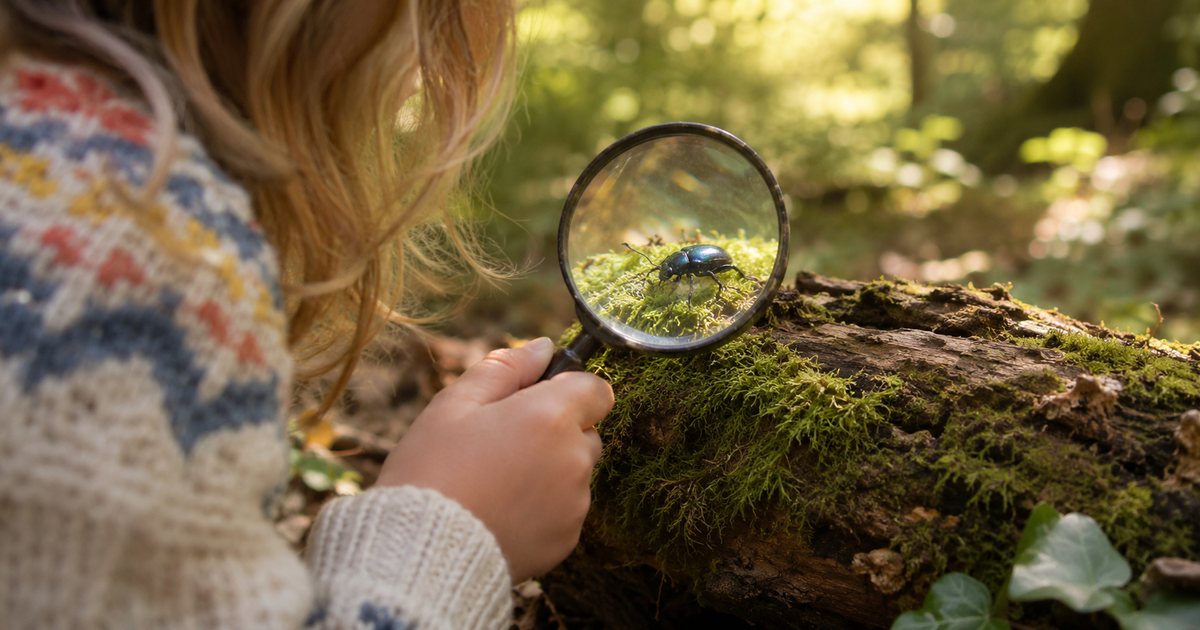
"Why is the grass wet?" Because it rained. "Why did it rain?" Because the clouds were full. "Why were the clouds full?" You're on the fourth why before you've reached the end of the road, and you're starting to wonder whether you ever actually knew how clouds work. Meanwhile your child has spotted a stone by the gate and is already trying to turn it over.
That restless, poking, asking itch is curiosity. It can be tiring, and it can come at the least convenient times. But it's one of the brightest things in a child: the urge to find out, and the trust that the world is worth finding out about.
How curiosity shows up
In children of three to five, curiosity is mostly hands and mouths and questions. They touch everything, open every cupboard, pour water from one thing into another just to see. The "why" phase arrives, and with it a stream of questions that loop back on themselves. Some aren't really asking for an answer; they're asking you to keep talking with them.
From six to ten, curiosity tends to settle on particular things. Dinosaurs, volcanoes, how bodies work, what's at the bottom of the sea. They might collect stones, feathers or facts, and want to tell you all of them. Questions become harder: about death, about fairness, about where everything came from.
It can hide as mischief. A child who takes the clock apart or digs up the flowerbed is often not being naughty at all, just very interested in what's inside.
Why the questions keep coming
Children are built to learn by exploring. Every new thing they touch or ask about helps them make sense of how the world fits together. For a young child, nearly everything still has a mystery in it, so there's an awful lot to find out.
Curiosity also needs a little safety. Children explore most freely when they know a trusted grown-up is near, and when their questions are welcome rather than brushed away.
When the whys won't stop
You don't need to know the answers. "I don't know, what do you think?" is a lovely reply, and so is "Let's find out together." It tells a child that not knowing is the start of something, not a failure.
When you're tired, it's fine to say so kindly. "That's a big question. Can we save it for after tea?" Then try to come back to it. Curiosity doesn't need every question answered; it needs to feel welcome.
And when the curiosity is hands-on, like turning stones, opening seed pods or poking a puddle, let it happen where it safely can. Show them how to lift a stone gently and put it back the way it was, so whatever lives underneath can go on living there.
- Turn it backTry "what do you think?" - it keeps the conversation going without needing every answer.
- Find out togetherNot knowing is fine; say you'll look it up or go and see together.
- Save it for laterWhen you're tired, kindly park the big question and come back to it after tea.
- Lift gentlyShow them how to turn a stone softly and put it back just as it was.
Mia, the belovedIn the stories, Mia travels the worlds with her eyes wide and her arms open, curious about herself and proud of what she finds. Meet Mia
Out among the questions
Outdoors is where curiosity has the most to work with. Keep a small magnifying glass by the door and take it on walks. Lift a log, peer into a rock pool, follow an ant trail, collect a few fallen leaves and compare them at home. Let your child lead, and ask rather than tell: "What do you think lives in there?"
A simple nature notebook can help older children hold onto what they find, with quick drawings, the date and their own questions. Questions with no answer yet are welcome too. If your child's curiosity hops quickly from thing to thing, our guide to growing attention in children explores how slow, outdoor time helps focus too.
Curiosity is close kin to wonder, the quieter, stiller feeling that often follows a really good discovery.
What you'll need
- A small magnifying glass by the door
- A log or stone to lift and put back
- A nature notebook and a pencil
- Time to explore with no plan
Our tips
- Try "what do you think?" You don't need to know every answer.
- Tired? Kindly save the big question for after tea, then come back to it.
- Show them how to lift a stone gently and put it back just as it was.
For the fridge: one small step a day
- MonTurn a why back: what do you think?
- TueTake the magnifying glass on a walk
- WedLift a log gently, then put it back
- ThuFollow an ant trail together
- FriFind out one answer together
- SatCollect leaves and compare them at home
- SunAsk: what do you still want to find out?
Words to try
- "Ooh, good question. What do you think?"
- "I don't know. Shall we find out together?"
- "Let's look a bit closer."
- "Gently - and then we put it back where we found it."
- Try asking (afterwards): "What's one thing you still want to find out?"
A week to try
For the fridge: one small step a day
- MonMagnifying-glass walk: lift a log, then put it back 20 mins
- TueAnswer one "why" with "what do you think?" 0 extra mins
- WedFind the creatures hiding in plain sight 15 mins
- ThuStart a nature notebook: one drawing, one question 15 mins
- FriDig a small hole and meet who lives there 20 mins
- SatLong wander with no plan, child leads 1 hour
- SunAsk: what do you still want to find out? 10 mins
We will put each day on your family calendar, starting today, with the matching mission ready to open.
Questions parents ask
Is it normal for my 4-year-old to ask why all the time?
Yes, completely. The "why" stage usually peaks around three to five, and it's a sign of a busy, growing mind. Not every why needs a full answer. Sometimes turning it back with "what do you think?" is more fun for both of you, and it helps them start working things out for themselves.
How can I encourage curiosity in my child?
Make time to explore without a plan, especially outdoors, and let them lead. Welcome questions, even the ones you can't answer, and find things out together. Keep a few simple tools to hand, like a magnifying glass or a notebook. Most of all, show your own curiosity: children copy grown-ups who still wonder about things.
My child takes things apart and gets into everything. Should I worry?
Usually not. This is often curiosity in its most hands-on form. Make the house safe, then give it somewhere to go: old gadgets to unscrew together, a patch of garden to dig, sticks and stones to build with. Channelled kindly, the urge to see how things work is a real gift.
Wundoria is a set of eight story worlds for children aged 3 to 10, where every story ends with missions to do outside together. Our guides are written to support everyday family life; they are not medical advice. If you are worried about your child, talk to your GP or health visitor.
Play world one free All of feelings