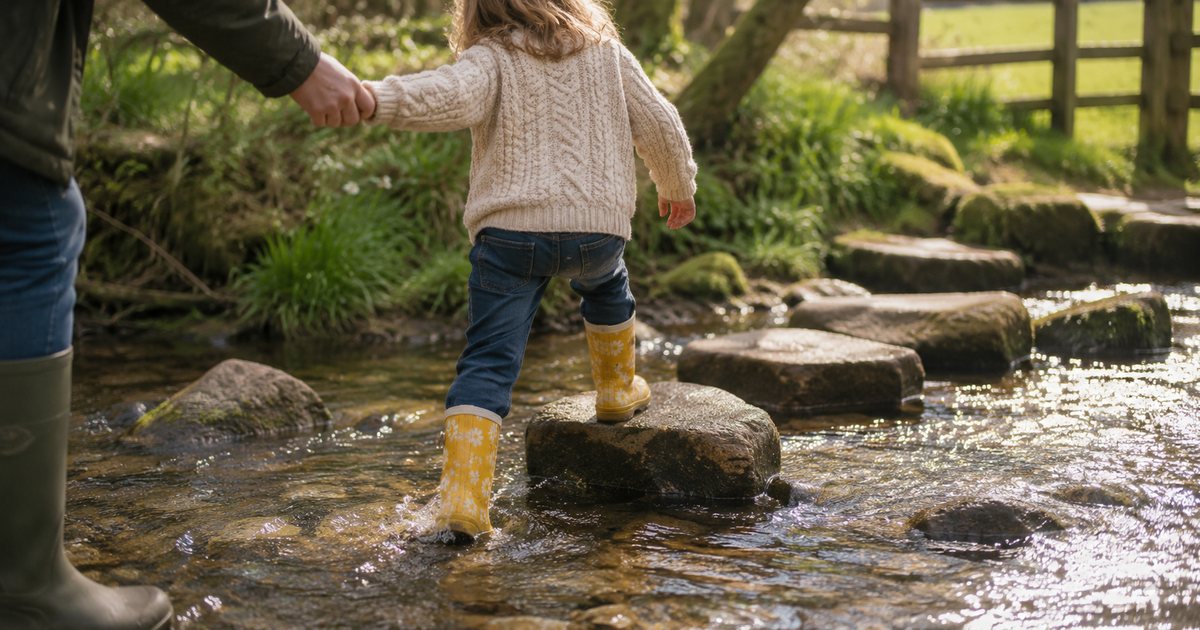
The stepping stones across the stream aren't far apart. You've watched other children hop across them without thinking. Your child stands at the first one for a long time. Arms out, eyes fixed, one foot hovering. They look back at you. Then, very slowly, they put a foot on the stone, and then the other, and they're standing on it, wobbling, astonished.
That's bravery. Not the absence of fear, but feeling it and taking one small step anyway. It rarely looks like a superhero. It looks like hovering feet and a face full of concentration, and it deserves to be noticed every time.
What brave looks like at different ages
For children of three to five, bravery is often physical and very visible: the first go down the big slide, putting a hand in the cold sea, saying hello to the dog. It usually comes with a look back at you, checking you're still there. That glance is part of the brave thing, not a sign of weakness.
From six to ten, bravery moves inwards as well. Putting a hand up in class. Telling a friend they didn't like something. Going to a party where they only know one person. Trying something they might be bad at. These can be invisible to everyone but the child.
Bravery hides, too. It can look like a child who says "no" five times and then quietly joins in on the sixth. Or one who asks endless questions before trying, because knowing more is how they gather their courage.
Why it takes so much
Every child carries a natural pull towards safety and a natural pull towards new things, and bravery is the moment the second one wins. For a small child, lots of things are genuinely new and genuinely big. Of course their knees wobble.
Courage grows from having somewhere safe to step out from and come back to. Children are bravest when they know a steady grown-up is nearby, ready to catch them, but not rushing in.
When they're working up to it
The hardest part, as a parent, is often the waiting. Try not to push, and try not to rescue too quickly either. Stay close, stay calm, and let them set the pace. A child standing at the edge of something is already being brave.
Notice the feeling out loud, without making it bigger. "That looks a bit wobbly. You can take your time." Then, when they do it, notice the effort rather than the outcome. "You were scared and you did it anyway" lands deeper than "well done".
And if they decide not to today, that's alright too. Stepping back is part of learning where their edges are. There's always next time, and the stones will still be there.
- Stay closeStand near enough to catch them, calm and steady, without rushing in.
- Let them set the paceDon't push and don't rescue; standing at the edge is already brave.
- Name the wobbleSay gently that it looks a bit wobbly and that they can take their time.
- Notice the effortAfterwards, praise that they felt scared and tried anyway, not the result.
Sun Sparkle, the smiling sunIn the stories, Sun Sparkle shows that your brightness is always there, even on cloudy days, waiting to be remembered. Meet Sun Sparkle
Small brave things outside
Nature is full of just-right risks. A log to balance on, a low branch to climb, a puddle of unknown depth, a stream to cross. Choose places where the challenge is real but the fall is short, and let your child try things a little beyond what they managed last week. Stand close, keep your hands ready, and keep your worries quiet. Near water, stay right beside them.
Another gentle habit is a "first time" walk now and then: a new path, a different wood, the beach in winter. Unfamiliar places ask a little courage of everyone, and doing it together makes it feel like an adventure. For more on growing steady self-belief, see our guide to building confidence in children.
Bravery often sits beside nerves, and afterwards it tends to bloom into pride.
What you'll need
- A log, low branch or stepping stones
- Wellies for puddles of unknown depth
- A new path or wood to explore
- Plenty of time to wait at the edge
Our tips
- Stay close and calm. Standing at the edge is already brave.
- Say "that looks a bit wobbly, you can take your time" and let them set the pace.
- Afterwards, praise that they felt scared and tried anyway.
For the fridge: one small step a day
- MonSay "I'm right here" before a new thing
- TueBalance along a log, hands ready
- WedTry a puddle of unknown depth
- ThuNotice the effort, not the result
- FriClimb one branch higher than last time
- SatTake a "first time" walk somewhere new
- SunAsk: what did it feel like just before?
Words to try
- "You can take your time."
- "I'm right here."
- "Your knees are wobbly and you're still trying. That's brave."
- "You can stop whenever you need to."
- Try asking (afterwards): "What did it feel like inside, just before you did it?"
A week to try
For the fridge: one small step a day
- MonPick one small challenge just past last time 15 mins
- TueNotice a brave moment out loud: scared, and did it anyway 0 extra mins
- WedWalk a path you have never taken 30 mins
- ThuHands on bark, roots from your feet, before something new 5 mins
- FriOne small hello to someone new 10 mins
- SatBack to Monday's challenge, one step further 30 mins
- SunTalk: what felt brave this week? 10 mins
We will put each day on your family calendar, starting today, with the matching mission ready to open.
Questions parents ask
How can I help my child be brave without pushing them?
Offer small, real challenges and let your child choose the pace. Stay close and calm, so they know you're there, but avoid stepping in too soon. Praise the effort and the feeling of being scared, not just the result. Over many small moments, children learn that fear and trying can go together.
Why is my child scared of things they used to do happily?
This is very common. As children grow, they understand more about what could go wrong, and new fears can appear alongside new skills. A tired or unsettled week can also make things feel bigger. Go gently, return to easier versions, and let confidence rebuild without pressure. It usually comes back.
Is it okay to let my child take small risks outdoors?
Yes, within sensible limits. Climbing, balancing and exploring on safe-enough ground help children learn what their bodies can do and how to judge danger. Check the space first, stay nearby, and let them stretch a little further each time. Short falls and scraped knees are part of how bravery is learned.
Wundoria is a set of eight story worlds for children aged 3 to 10, where every story ends with missions to do outside together. Our guides are written to support everyday family life; they are not medical advice. If you are worried about your child, talk to your GP or health visitor.
Play world one free All of feelings