You are late, of course. Shoes are on, the bag is packed, and halfway down the path your child stops dead. There is a snail on the wall. Not a special snail. Just a snail, slowly putting its horns out and pulling them back in. And your child is utterly still, mouth slightly open, as if nothing in the world has ever been this interesting.
That stillness has a name. It's wonder: the quiet, wide-eyed feeling of meeting something marvellous and not needing to do anything about it. It isn't a problem to solve. It's one of the loveliest things a child carries, and it grows best when a grown-up notices it and slows down too.
How wonder shows up
In children of three to five, wonder is mostly in the body. They freeze, crouch, point, or go suddenly silent. They might whisper, as if the thing might hear them. They ask to see it again, and again, and again. The same puddle can hold them for a surprisingly long time.
From six to ten, wonder starts to come out as questions. Where does the snail go in winter? How far away is that star? Why is the sky that colour now? Sometimes it shows up as a long, faraway look out of the car window, or a sudden need to tell you something at bedtime that they noticed hours ago.
Wonder can hide, too. It can look like dawdling, like not listening, like being "away with the fairies". A child who seems to be ignoring you on a walk may simply be busy being amazed by a lichen-covered stone.
Why children feel it so often
For a young child, almost everything is still new. They haven't learned yet to sort the world into the interesting and the ordinary, so a beetle and a rainbow get the same full attention. Their eyes are closer to the ground, where most of the small marvels are.
Wonder also needs a bit of space. It arrives when nothing is rushing, when there's a pause long enough for a child to really look. That's why it so often appears on the way to somewhere, in the gaps between the plans.
When wonder stops them in their tracks
The kindest thing is usually to stop with them. Crouch down, get to their level, and look at what they're looking at. You don't need to explain it or turn it into a lesson. A whispered "oh, look at that" says more than a fact ever could.
If you truly can't stop, give it a small promise rather than a brush-off: "We'll come back and see if it's still here after school." Then try to keep the promise, even for a minute. Children notice when their wonder is taken seriously.
And let yourself feel it too. You don't have to fake amazement. Look long enough at almost anything, a snail's shell, the veins in a leaf, frost on a car roof, and something real usually turns up.
- Get down lowCrouch to their level and look at exactly what they're looking at.
- Say very littleA whispered "oh, look at that" says more than any fact could.
- Give it a minuteLet the moment run a little longer than feels convenient, if you can.
- Promise a returnIf you must go, promise to come back and see if it's still there.

Moon Smile, the crescent moonIn the stories, Moon Smile shows that the mystery of the night sky is the same mystery as you. Meet Moon Smile
Making room for small marvels
Wonder grows with a little room and a lot of repetition. One gentle habit is a slow walk: the same short route, once a week, with no destination and no hurry. Let your child lead and stop wherever they like. Over the seasons, the same hedge becomes a different hedge, and they start to notice what has changed.
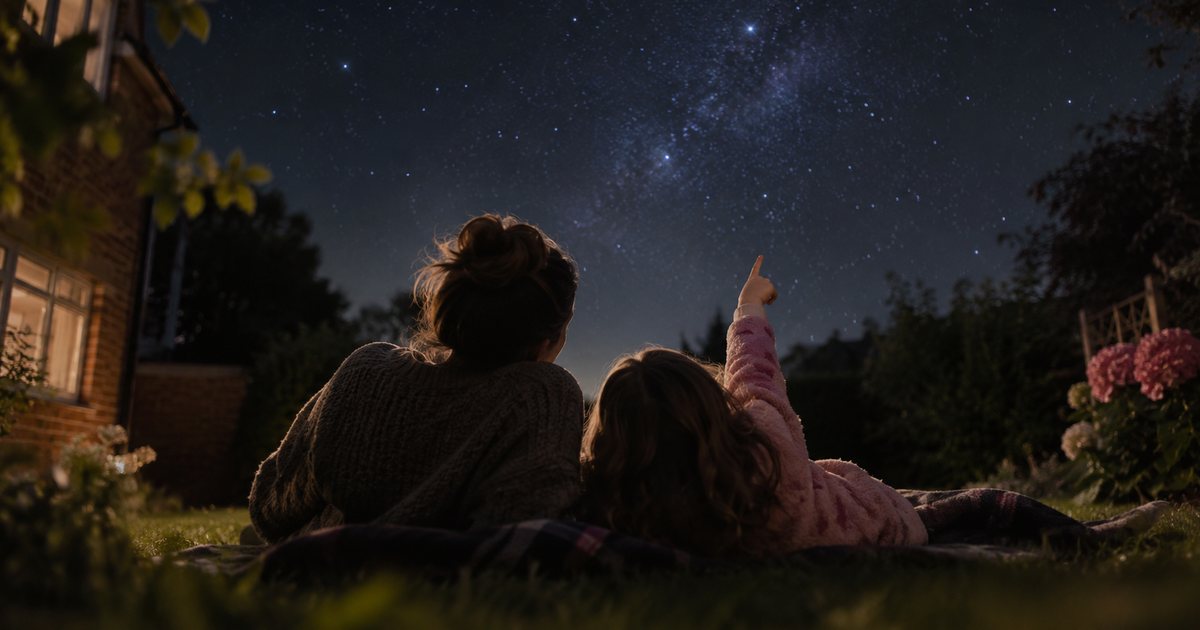
Another is looking up at night. A few minutes on the back step after dark, a blanket round your shoulders, watching the moon change shape across the month. Children who are a little older might keep a simple moon diary. If the outdoors has become harder to get to, our guide to helping a child who won't go outside has gentle ways back in.
Wonder sits very close to curiosity, its busier cousin, and often leaves a child feeling calm afterwards.
What you'll need
- A few spare minutes on every walk
- The same short route, once a week
- A blanket for the back step after dark
- A small notebook for a moon diary
Our tips
- Crouch down to their level and look at exactly what they're looking at.
- A whispered "oh, look at that" says more than any fact could.
- If you must go, promise to come back and see if it's still there.
For the fridge: one small step a day
- MonLeave ten minutes early to dawdle
- TueCrouch down and watch a snail together
- WedGo out after dark and find the moon
- ThuLook closely at the veins in a leaf
- FriKeep a promise to go back and look
- SatA slow walk where they lead the way
- SunAsk: what was the most amazing thing?
Words to try
- "Oh. Look at that."
- "Shall we just watch it for a bit?"
- "What do you notice?"
- "We can come back tomorrow and see if it's changed."
- Try asking (afterwards): "What was the most amazing thing you saw today?"
A week to try
For the fridge: one small step a day
- MonSlow walk with no destination; stop wherever they like 20 mins
- TueCrouch down and look at what they're looking at 0 extra mins
- WedLook into still water until it shows the sky 10 mins
- ThuFind the creatures hiding in plain sight 15 mins
- FriThe moon from the back step, blanket round you 10 mins
- SatLie on the ground at sunset and feel the earth turn 15 mins
- SunAsk: what was the most amazing thing you saw this week? 10 mins
We will put each day on your family calendar, starting today, with the matching mission ready to open.
Questions parents ask
How can I encourage a sense of wonder in my child?
Mostly by slowing down and joining in. Children feel wonder easily; what helps it last is a grown-up who stops, crouches and looks too. Short, regular time outdoors, the same places visited across the seasons, and plenty of unhurried gaps in the day all give it room. Facts can wait. Shared attention is what matters most.
Is it normal for my child to dawdle and stare at things on walks?
Yes, very. Young children take in the world slowly and thoroughly, and what looks like dawdling is often deep attention. It can be maddening when you're late. Where you can, build a few extra minutes into the walk, and save the faster pace for the times when it really matters.
Will my child lose their sense of wonder as they get older?
It can fade if days become very rushed or full of screens, but it rarely disappears. Older children often show it differently, through questions, collections or quiet fascination with one thing. Time outside, especially at dusk or after dark, and a grown-up who still notices small marvels, keeps it very much alive.
Wundoria is a set of eight story worlds for children aged 3 to 10, where every story ends with missions to do outside together. Our guides are written to support everyday family life; they are not medical advice. If you are worried about your child, talk to your GP or health visitor.
Play world one free All of feelings